
Why Filipino Drivers Rarely Check Their Tires
Every rainy season, the same story plays out on Philippine roads. A vehicle hydroplanes, loses grip in standing water, or takes noticeably longer to stop — and the driver has no idea the tires were the reason. The tread had been wearing thin for months, but no one checked.
It is not a matter of awareness. Most drivers know that tires wear out. The problem is access. A proper tread depth gauge is not something most households own. A visit to a shop just to ask about tire depth can feel like an inconvenience when you are not sure anything is even wrong. So the tires stay on, and the risk stays invisible.
That changes today.
Enter the Piso Test
The one-peso coin is one of the most useful tire safety tools you already own.
Both the old and new designs of the Philippine one-peso coin are sized so that the distance between the edge of the coin and the lettering on the rim is approximately 1.6 mm. That number matters because 1.6 mm is the minimum acceptable tread depth recognized in Philippine inspection guidance and by tire manufacturers like Michelin.
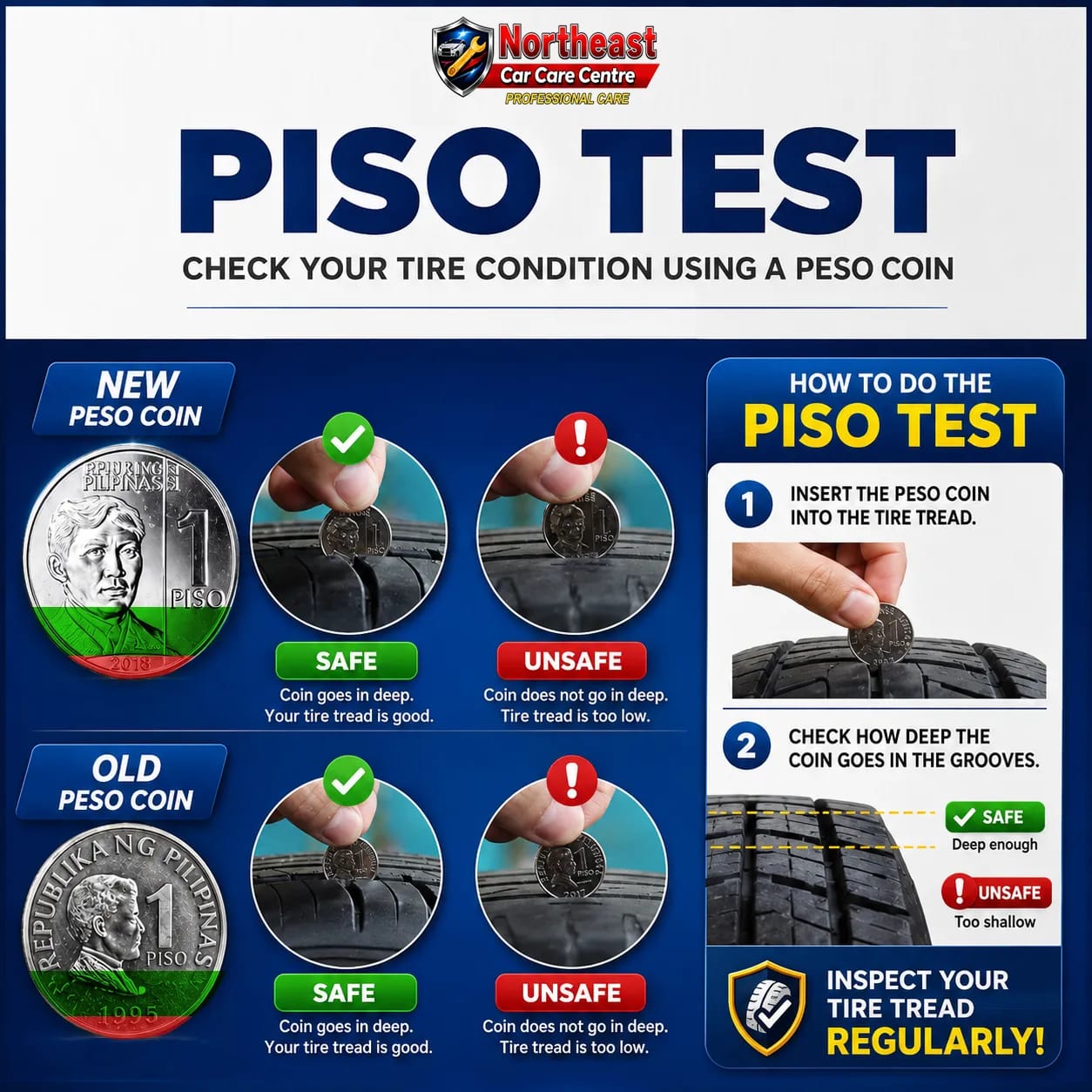
In other words, the coin was not designed as a tire gauge — but it works as one. Insert it into a tread groove. If the coin disappears past the rim well into the groove, you have usable tread remaining. If the coin barely enters the groove or the rim stays exposed, you are at or near the minimum. It is time to replace the tire.
No appointment needed. No equipment to buy. The test takes thirty seconds and can be done anywhere.
If the Coin Goes in Deep
You can see the rim disappear into the tread groove after you insert the coin. Your tires still have life in them. Continue monitoring regularly, especially before the rainy season or any long trip.
If the Coin Barely Goes in
The rim is visible. Your tread is at or very close to 1.6 mm. This is not a "wait and see" situation. At this depth, wet-road braking is already weaker than it should be. Replace the tire before your next trip, and especially before driving in rain.
How to Do the Piso Test
- Take a one-peso coin — old or new design both work — and hold it between your thumb and forefinger.
- Insert the coin into the tread groove, pushing it straight down into the deepest channel on your tire.
- Check how deep the coin sinks into the groove. If it disappears well past the rim, you're good. If it barely goes in, it's time for new rubber.
- Repeat across multiple grooves and different spots on each tire — wear isn't always even across the full width.
Check All Four Tires — Plus the Spare
Tire wear is not always even across all four wheels. A front tire that steers and brakes can wear faster than a rear tire on the same vehicle. A tire that has been running slightly underinflated wears differently from one held at proper pressure.
Do the Piso Test on every tire individually. Do not assume the other three are fine because one passed. Check the inner, center, and outer tread on each tire because wear patterns can differ across the same tread face.
And check the spare. A spare that has sat unused for years may have hardened, cracked, or worn in storage. The Piso Test works on it too.
When the Piso Test Suggests You Need More Than Just New Tires
If one tire is wearing faster than the others, or if the wear is uneven across the width of a single tire, the problem is usually not just the tire itself. Alignment, suspension, inflation habits, or wheel balance can all create uneven wear. Replacing the tire without addressing the underlying cause will just wear out the new tire in the same pattern.
If you notice uneven wear, mention it when you visit for tire service. It is worth having alignment and suspension inspected at the same time.
Make It a Monthly Habit
The best time to do the Piso Test is once a month, and always before a long trip. Combine it with a quick tire pressure check — a visual look for cuts, bulges, or sidewall cracks — and you have covered the most common tire safety checks in under two minutes.
A peso coin. Thirty seconds. Every month. That is all it takes to stay ahead of one of the most common causes of road incidents on Philippine roads.
Need a Tire Inspection?
If the Piso Test suggests your tires are worn, or if you want a professional check of tread depth, alignment, and overall tire condition, visit Northeast Car Care Centre in Bantay, Ilocos Sur, or call 0917-578-0410.
Follow @northeastbosch on Facebook for more practical car care guides made for Filipino drivers.
Northeast Car Care Centre — Professional Care For Every Journey
References
These sources were used only to verify safety references and minimum tread-depth guidance. The article text above is original Northeast Car Care Centre educational content.
Join the discussion
0 Comments
Share a helpful thought or question about this article.